Agawa at KCIC (Korean Canadian Innovation Centre)
An evening with Toronto's Korean founders, and a reminder that for most companies entering Canada, the hard part isn't the product. It's everything around it.
Introduction
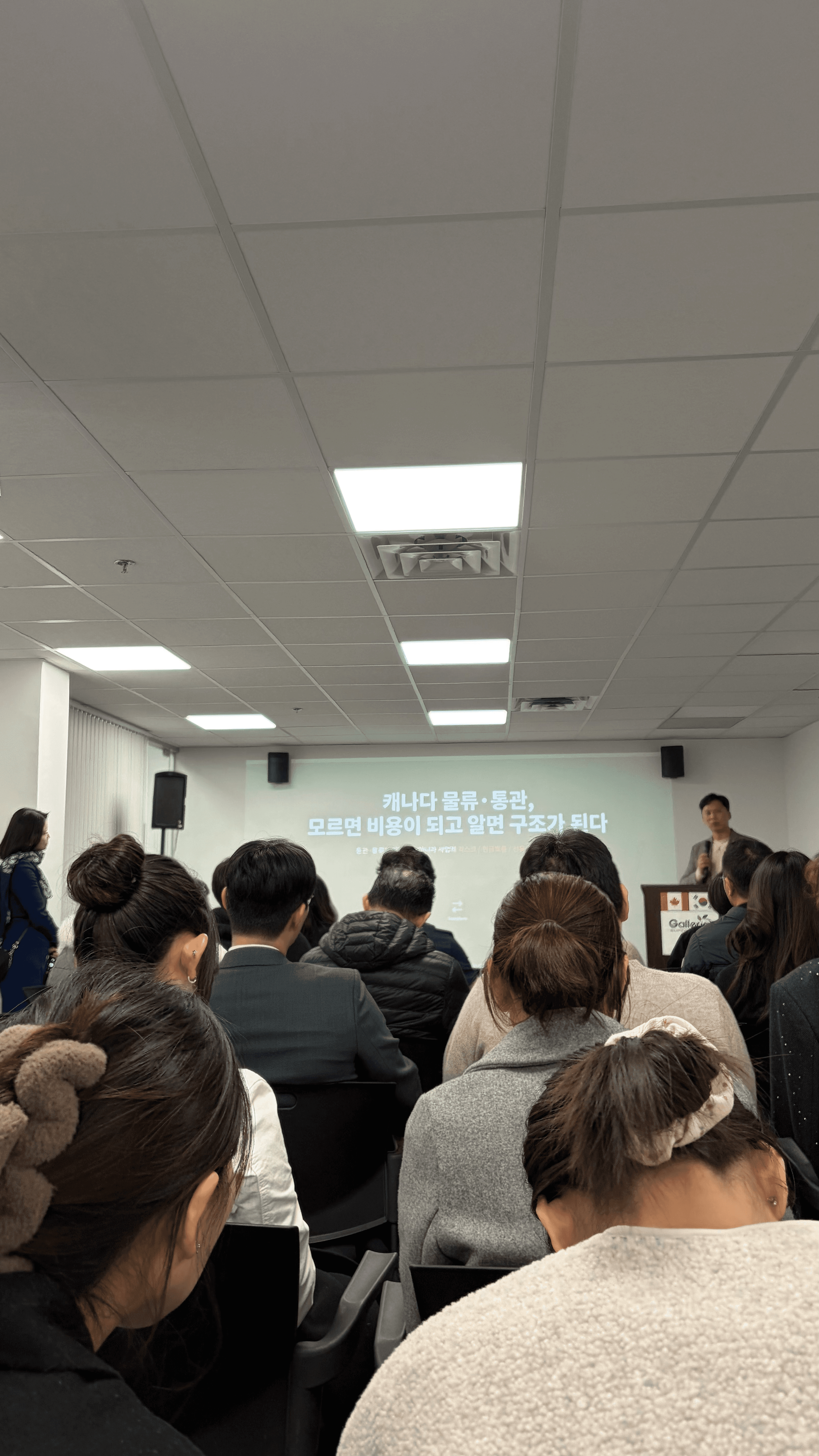
We spent an evening at KCIC's founder networking night in Vaughan, in a room full of people building businesses across the Korea-Canada line. Some were just starting. Some were already shipping product. But almost everyone, at some point in the night, ended up talking about the same unglamorous thing: logistics.
Content
There's a line from one of the night's presentations that stuck with us. Canadian logistics and customs: get it wrong and it becomes a cost, get it right and it becomes structure. That sentence captures something most market-entry conversations skip right past. When a company thinks about entering Canada, the energy goes to the exciting parts. The brand. The product. The first big customer. But the businesses that actually stall rarely stall on product. They stall on the parts nobody put on a slide: customs classification, duties, the freight forwarder who didn't flag a document, the first shipment sitting in a warehouse while the costs quietly stack up. The product was never the problem. The operations underneath it were. What made the KCIC room valuable was that these weren't theoretical worries. They were the lived experience of people in the seats, and of the partners in the room who solve these problems for a living. Distribution channels, customs, freight. The unglamorous infrastructure that decides whether a good product ever reaches a shelf. This is exactly the layer we think about for the companies we work with. Entering a new market isn't one decision. It's a chain of them, and the chain only holds if every link is handled by someone who has done it before. We don't pretend to do all of it ourselves. What we do is build the map, connect the right operators, and make sure nothing in that chain gets left to chance. The founder should be thinking about growth, not whether a pallet clears customs. Rooms like KCIC are where that map gets drawn. You meet the people who actually move the goods, learn where things break, and walk away knowing the terrain a little better than you did before. For the companies trusting us to get them into this market, that knowledge is the whole point.
Let's Work together
"Agawa doesn't just talk strategy. They understand what actually breaks when you try to enter a new market, and who to call when it does. That ground-level honesty is rare."

Founder & CEO - Deep Tech Startup, Korea
Most companies don't fail at the idea. They fail at everything around it. If you want a partner who handles the parts nobody warns you about, let's talk.